Monday, 22 July 2013

Why Automated Vehicle Zones (AVZs) Might Develop


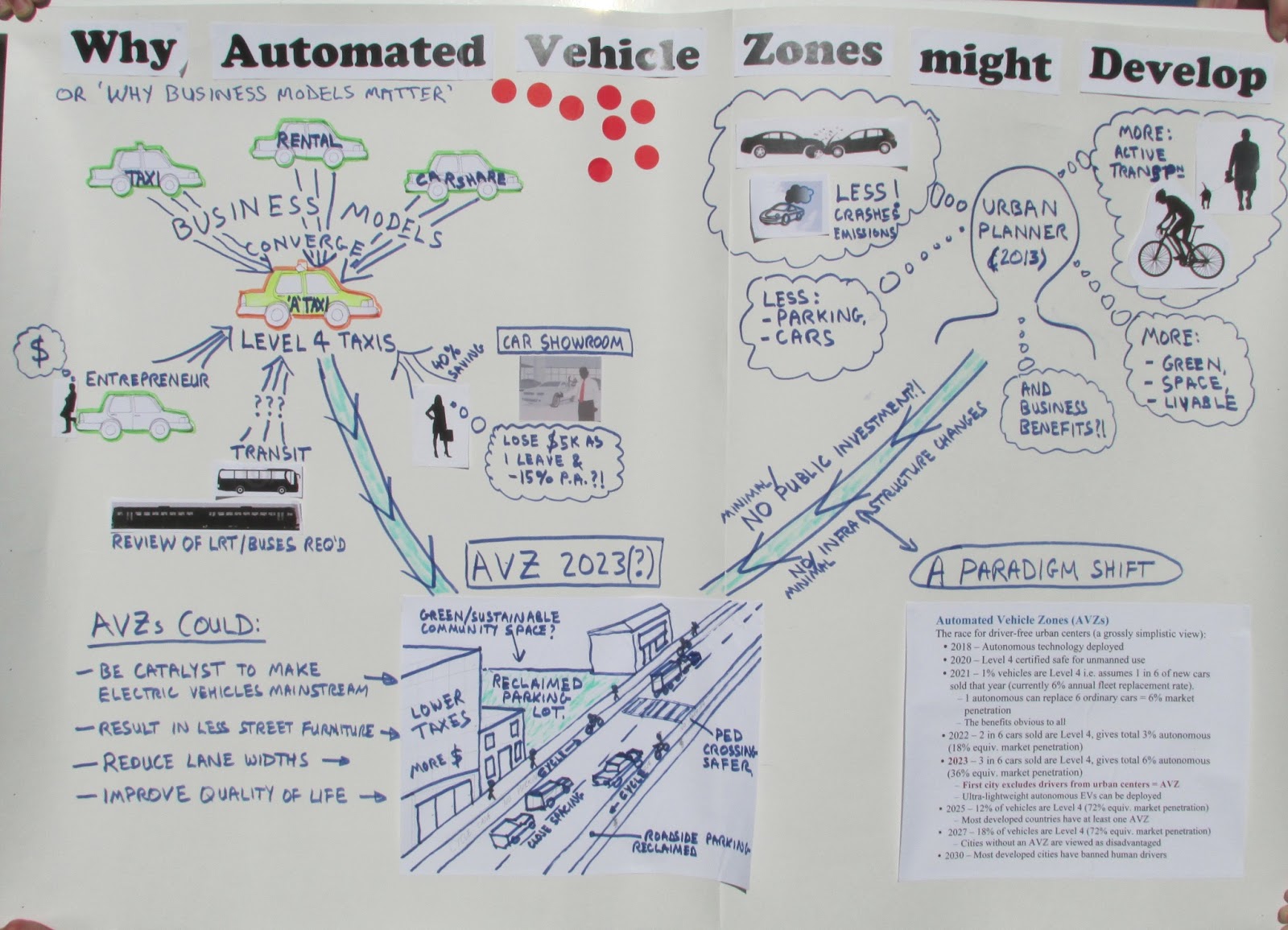
This is a poster that I presented at the TRB workshop on road vehicle automation at Stanford University (15-19 July 2013).  Please excuse the poor quality of production, but rather note the concept which generated a reasonable amount of interest amongst those TRB participants who stopped to discuss my poster.

In it I propose that if you follow the business models that result in the inevitable rise of fully automated (NHTSA Level 4) taxi fleets, and combine that with the aspirations of urban planners (reflecting the desires of many mayor's and councillors in major cities) then AVZs are a natural development of the convergence of these streams.

On the poster I assumed that Google would release their technology in 2018, with it being certified safe for unmanned use by 2020 - thus leading to the first AVZ, somewhere in the world around 2023.  But in a public session on the Friday, I asked the panel when NHTSA Level 4 technology might be deployed - and Anthony Levandowski of Google referred me to the comments made by Sergey Brin at the California Autonomous Vehicle bill signing ceremony on 25 Sept 2012.  At that time Sergey Brin intimated that the Google tech would be in public hands within five years - so in July 2013 we are looking at 2017 - that is 4 years and small change.

In which case, if I am correct with my business models and estimates for market penetration, we might see the first AVZ in 2020.  The competitive edge that any city might gain by switching to an AVZ is considerable - not to mention the quality of life, safety and emissions benefits.

Thursday, 18 July 2013

Google aspire to bring Level 4 Automation to market - maybe within 5 years

At the TRB workshop on road vehicle automation yesterday (Weds 17 July) Ron Medford made it clear that Google would like to bring a NHTSA Level 4 automation (i.e. capable of unmanned) product to market.  There are clearly many issues and hurdles, so no guarantees, but the Google aspiration is for this Level 4.

Last year, 25 Sept 2012, Sergey Brin intimated that they would have SDC tech in public hands within 5 years.  Earlier this year two separate Google SDC team members have stated that they would like to have the SDC tech in public hands within 5 years.

We shouldn't 'hang our hats' on these aspirations, but at the same time I take this as a very clear advance warning signal that we are now potentially running out of time to prepare for this.

For me this is a potential 'wow' moment.  Level 4, unmanned is the 'game changer' - which is the language used by the Director of the California DMV stated at the conference the previous day.  The clincher for credibility, in my opinion, came from there being a  Senior Researcher from the White House who spoke off the record.

Level 4 is the 'quantum leap', the 'paradigm shift', the 'game changer'.  If it is less than 5 years away then we don't have much time to prepare.

The Workshop has been incredible thus far - significantly more attendees than last year and the level of knowledge and awareness is so much greater. The public and private sectors are well represented and the language/mood of some has moved from guarded/skeptical to open and even excited.

Tuesday, 14 May 2013

Open Letter to the Prime Minister of Canada


I have written previously to the Prime Minister of Canada on 5 April 2013 urging his government to be aware of the impending arrival of autonomous vehicle technology and advising that the government needs to start planning now and that many ministries and businesses should be included in such planning.  The prompt reply from his office  said that my comments have been carefully considered and that they have taken the liberty to forward my e-mail to the Minister of Transport.

As 5 weeks have now passed and I have heard nothing further from the Prime Minister or the Minster of Transportation then with Barrie Kirk, my associate from Globis Consulting, we have co-signed a letter that Barrie wrote and sent it to both the PM and Cc'ed to the Minister of Transport.

If you too feel strongly about the issue of whether your jurisdiction is taking autonomous vehicles and their impacts seriously then please consider writing something yourself - such communications can sometimes make a difference.  Here is the letter that Barrie sent on our behalf:


Open Letter to the Prime Minister of Canada

Dear Prime Minister,

I am shocked that no Canadian government, federal, provincial, or municipal, is investigating the launch of autonomous vehicles and planning for the huge impacts on our cities, transportation, public transit, government and businesses. Compared to other countries, Canada is a backwater when it comes to planning for the introduction of self-driving cars.  Canada needs some leadership in this area and I urge you to provide that leadership now.

Let me review some of the activities in other countries:

U.S.
-  The Senate is holding a hearing on the technology and its impacts on May 15, 2013.
-  The Department of Transport has started to investigate the same topics.
-  Laws permitting testing of autonomous vehicles have been passed in Nevada, Florida, California, and Washington D.C.
-  13 other US States have similar bills in process.
-  Bill Ford, the Executive Chairman of Ford, has said "cars will soon drive themselves and ......it will all happen sooner than you might guess.".
-  The Earth Institute of Columbia University has published an important report on the huge impact of autonomous vehicles on public transit.

Europe
-  A number of governments have enacted laws related to autonomous vehicles.
-  The Sunday Times reports that the U.K. is about to change the law to to allow testing of autonomous vehicles on public roads.
-  A recent editorial in the The Telegraph said that autonomous vehicles will trigger a burst of economic growth, transform transport around the world, including in Britain, free vast amounts of time, increase productivity, make us a lot wealthier and unleash drastic, unpredictable economic and cultural changes." 
-  A recent newsletter published by Lloyds had an article on driverless cars that ended with the following: "The [insurance] market needs to monitor driverless cars and these new technologies – and their associated risks – as they evolve during the next few years. Completely ignoring this scenario is not a good option."

Japan
-  Hitachi has commercially launched a low-speed, single-seat autonomous car for seniors and the handicapped. (Canadian universities and businesses have the skills and resources to have developed this -- why didn't we?)

Car manufacturers
-  GM, Volvo, Nissan, BMW, etc. say their first fully-autonomous cars will be launched in 2020.
-  Google is expected to have its self-driving car technology in the public's hands even sooner.
-  Cadillac has started testing a semi-autonomous car that will be launched even earlier than that.

There are very many benefits, as well as some issues.  Planning for autonomous vehicles will take time and will involve many different federal departments, as well as provincial and municipal governments.    Leadership needs to come from the top, as it has in the US and the UK.  I urge you to provide that leadership and start now the process of planning for the huge impacts on our cities, transportation, public transit, government and businesses.

Yours sincerely
Barrie Kirk, P.Eng.
and
Paul Godsmark
Friday, 10 May 2013

Who Will Champion the Cause of Autonomous Vehicles?

I have just returned this week from presenting at the Canadian Council of Motor Transport Administrators (CCMTA) where the subject of autonomous vehicles was mentioned by each of the speakers in the opening session.  Following my presentation it then came up for discussion under the general heading of emerging issues in the three main committees.  Autonomous vehicles were probably 'the' hot topic of the Annual Meeting.

There was considerable interest in my presentation and a huge variation in familiarity with the technology and the implications by the attendees.  Hopefully by attending I have helped some to improve their understanding of autonomous vehicles and challenged some others on just how broad the implications could be on surface transportation and society as a whole.

My CCMTA presentation can be downloaded here.

The only reason that I could make it to the incredible city of Iqaluit, Nunavut, which has no roads to it and is the closest that I have ever been to the arctic circle, is through the very generous sponsorship from CCMTA for the speakers.  There are a number of conferences and annual meetings that I would really like to attend and speak at this year, but resources are simply not available.  Yet surely this subject, which has the potential to have the biggest impact on society since the internet, should command much greater attention and have funds flowing into it already?

So, my question is, applicable in every jurisdiction: 
"Who will champion the cause of autonomous vehicles?"

The CCMTA are possibly now the most aware organization with national influence in Canada, and they have a vital role in bringing order to the way that vehicles are licensed and used on the roads and how the roads operate safely and efficiently.  But, and this is the 'but', the implications of the autonomous vehicle when they are certified safe to drive unmanned go way beyond our road networks.  They will impact on almost every aspect of daily life and affect almost every government ministry and department and impact on so many businesses.

My hope is that the CCMTA will recognize that this subject, although it falls firmly within their remit of license and regulation, is also potentially 'above their pay-grade' and therefore pass their observations up through the chain of command to the Minister of Transportation and hopefully the Prime Minister.

I do not see how we can begin to address the massive societal change that unmanned autonomous vehicle capability will bring unless we use joined-up-thinking and involve decision-makers representing the key stakeholders in government, business and society.

To that end it is very encouraging that the U.S. Senate Committee on Commerce, Science, & Transportation is holding a hearing on 15 May titled: "The Road Ahead: Advanced Vehicle Technology and its Implications".

But even now we are making decisions on major public transportation projects and committing funds for projects that will take decades to pay for, with no cognisance of the impacts of autonomous vehicles in possibly as little as five years time.

We simply cannot act soon enough if we want to make best use of public funds and tax-payers interests in my opinion.  So, who will champion the cause of autonomous vehicles and ensure that our limited resources are used as wisely as possible?

Tuesday, 7 May 2013

Autonomous Vehicles: An Inconvenient Truth

Just to let you know that I will be presenting on the subject of "Autonomous Vehicles: An Inconvenient Truth" on a free webinar, hosted by Globis Consulting on Wed May 22 at 11:00am EDT.


Registration for the webinar is here.

My presentation will briefly outline the basics of autonomous vehicle technology, what the paradigm shift will be, and how I see autonomous vehicles  being deployed as a result of the likely money flows and business cases. 
This will serve as useful background knowledge to then help you understand the 'Inconvenient Truth' that I refer to in the title.  This relates to a number of issues which you may already be aware of, if you have been following the development of this technology closely. If we only look at these issues from the perspective of the existing paradigm then they are robust 'positions' that have stood the test of time.  However, I trust that you will agree that the forecast from many voices is now that change is definitely on the way and that it is no longer 'business as usual'.


When we look from the perspective of the new paradigm, then it becomes clear that the positions taken by these organizations will be impacted, if not disrupted. It is therefore my opinion that these issues need to be openly discussed so that we can all gain a better understanding of what may happen in the future and how we can best prepare for it. 


There is still plenty of time to act, if that is considered necessary.  But given how long it can sometimes take government and businesses to understand and act on an issue, then we hope that at the very least this presentation will raise awareness and provide decision-makers with some 'food for thought'.


If we don't discuss and tease out where we stand with these issues, then there is the risk that we could waste billions in public spending and that many company business models could disrupt and cause them to go bust.


Monday, 29 April 2013

The Inevitable Rise of Autonomous Vehicle Fleets


Following significant further investigation of the potential impacts of the deployment of autonomous vehicles it appears that the overall impact on society could be even greater than that of the internet.  In a sense the internet was essentially a ‘virtual revolution’, whereas this will be a ‘real revolution’.  Why do I think this?

To understand this more clearly, then the paradigm shift itself needs to be understood and put in the context of the societal norms where it will be introduced.  For this post I will confine myself to the North American context.

Several of the special guests that have been permitted rides in the Google self-driving car in public roads have made similar comments along the lines of Coby Chase, TxDOT’sdirector of government and public affairs at the Texas Transportation Forum inFebruary 2013: “The remarkable thing was that it was a little unremarkable.”

Similarly the paradigm shift appears unremarkable – it is simply that a vehicle can travel unmanned.  But when we start to unravel this novel concept then we find that it has profound and remarkable implications for society:
  1. A vehicle that can drive unmanned can do work by carrying people and goods.
  2. A vehicle that can do work can make money for its owner.
  3. A vehicle that can make money will be in great demand in a free-market economy.
But again, this initial unravelling doesn’t reveal the breadth of the impact of the autonomous vehicle.  So allow me to sketch out a possible implementation scenario that will unravel the new paradigm a little more.

Once the autonomous vehicle is certified safe for unmanned use then a number of businesses/sectors will be more than ready to purchase this technology.  In fact I expect that their orders will have been placed many months or even years in advance, as if they don’t utilize the cost saving and efficiency benefits of the autonomous technology then they will lose out to their competitors:
  • The trucking industry – by removing driver costs, reducing fuel costs and reducing maintenance costs then they can maintain profit margins and still the price of goods in shops will reduce.
  • The taxi industry – any good taxi driver knows this technology and ‘this day’ is coming.  For a New York Taxi the driver is approximately 57% of the cost of a ride – it is difficult to see how they could compete with autonomous taxis.
  • Car rental companies – most users will quickly realize that that hiring an autonomous car only when transportation is needed will be cheaper than a longer hire of an ordinary vehicle that is likely to be unused most of the time.  Also their rental autonomous vehicles will suffer less damage, require less maintenance and overall be cheaper to run and allow them more flexibility on not requiring returns to a specific location.
  • Car-share companies – their business models will naturally migrate to autonomous technology as it a simple progression of their existing models.
  • Ride-share companies - their business models will naturally migrate to autonomous technology as it a simple progression of their existing models.

You will note that a common theme is emerging here.  The early adopters all run fleets.  But what will happen is that (apart from the trucking industry) their business models are converging – they will now in fact be competing against each other.

But what about the average person?  The more entrepreneurial minded individuals will realize that with an autonomous vehicle that they will be able to use it for their commute to work, but they can then assign it to an ad-hoc autonomous taxi company operating in the ‘cloud’ that will, for a small fee, hire it out to those in need of transportation, at cheaper rates than even the taxi companies.  Users in need of a vehicle simply use a mobile device such as a smart phone or Google Glass etc. and send the details of their travel requirements to the cloud. Before the time that the vehicle is due to be returned to the owner then the cloud based company can have arranged for any maintenance, cleaning and re-fueling.  Thus the owner might actually make a small daily profit, even allowing for depreciation – which is a considerably better financial situation than an ordinary car which sits idle for around approximately 95% of the day.

Again – the fleet theme is repeated.  This time with private individuals and their low overheads and low profit expectations against the aforementioned business based autonomous vehicle fleets.

But what about public transport?  Well it is easy to see that bus services could be severely impacted.  They require riders to travel to and from fixed bus stops and will therefore have a lower level of service and probably have a lower quality feel than using an autonomous taxi.  Those buses serving high density corridors will always have the advantage of being able to densely pack passengers into a single ‘metal box’, but on any routes where road space is not at a premium then some, if not all ridership, could be lost to the autonomous taxis.  This leaves the bus operators with an interesting dilemma – of how to adapt their operational and business models to survive, or even thrive in this new environment.  The use of autonomous buses is certainly an option, but research is definitely needed to determine what might be an optimum solution.

And LRT?  Again the principle of high density corridors ensures the continuing need for LRT, but the lower-ridership peripheral routes may need review as to their continued viability.  What is of concern to the fiscally minded, is whether the operational, business and revenue models for proposed LRT lines or extensions are sufficiently robust for their plans and designs to continue being designed from within the existing paradigm.  When the large capital costs of LRT construction is taken into account, and the operational subsidy that most service require, an autonomous taxi alternative, funded by the private sector, may begin to look a very attractive alternative.

So there appears to be market forces at work, because autonomous vehicles can make their owners money, that could lead to rapid deployment and a certain degree of market penetration.  But there is another very significant market dynamic, or trend that will come into play as well.  That is the rapidly growing trend of the ‘shared economy’ which is well illustrated by the rapid growth of carshare and ride-share services, especially in trend-setting hubs such as San Francisco and other Californian cities.  This is clearly seen in the statistically significant reduction in ownership of cars by the younger demographics and the rising average age of gaining a driving license and the fact that they simply don't drive as much as in the past.  Much of this is related to greater awareness of environmental and sustainability issues from education, as well as a growing addiction to social media – where driving has now become the distraction.

Proof can be found in the claims from carshare companies, such as Car2Go who operate in Calgary who in conversation with myself claimed that a single Car2Go vehicle can replace up to twenty privately owned vehicles.  A review of research shows that one car-share vehicle can be seen to remove between nine and thirteen other vehicles from the roads.  This principle can be expected in autonomous vehicle fleets, and a study by the Earth Institute (EI) of Columbia University “Transforming Personal Mobility” indicates that in a successful autonomous fleet one autonomous vehicle could replace approximately six private cars.  In addition, the EI authors found that by relinquishing private car ownership that the average person could reduce their annual transportation costs by approximately 40% when using conventional cars as the base for the autonomous vehicle.  But when ultra-lightweight electric powered autonomous vehicles are used then the cost can reduce by up to 80%.  For an average person these savings could be significant multiples of their current disposable income and could result in substantial quality of life improvements.

So overall it appears that there are safety, efficiency, financial and environmental benefits for users to switch from privately owned cars to autonomous vehicles, but even greater advantages if they relinquish ownership of private vehicles and use fleet autonomous 'taxis'.  Those that continue to drive themselves will actually be sub-optimal road users in a number of situations, especially in dense traffic as for safety they should maintain larger headways due to slower reaction times.

How could this all affect our cities?  Well this is where we see a very interesting challenge emerging.  Most North American cities it seems would like to make their streets much more liveable and desirable places to be – hence the rise and rise of concepts such as ‘reclaim the streets’ and ‘complete streets’.  The desire is for pedestrians and cyclists to be actively encouraged and to remove as much fast-moving, dangerous and polluting traffic from urban streets as possible.  We see so many opportunities to move towards these ideals with the deployment of autonomous vehicles.

Firstly the requirements for parking will reduce dramatically as the autonomous vehicles can simply drop riders off and then either proceed to free parking outside of the inner city area, or be available for the next hire through the cloud.  This gives rise to the interesting question of ‘What do we want to do with this reclaimed land and these re-claimed parking structures?’.  We suspect that the urban planners and the private developers could have diametrically opposite desires here – which is why it could be very important for city planners to review policy at an early stage.

Secondly, because of the efficiency that autonomous vehicles will move through inner-city streets, as mentioned earlier, the human drivers will be highlighted as the sub-optimal element.

Thirdly, because autonomous vehicles will be the most courteous and safest of drivers, the opportunity to promote pedestrian and cyclists facilities above autonomous vehicles will be an enticing possibility for urban planners.

Finally, as autonomous vehicles won’t crash as much there will be a desire for them to shed up to three quarters of  their weight.  That is the weight that current vehicles carry simply because we require that they protect us in the case of a crash, which 95% of the time will be as result of human error.

When these factors are combined it is possible to identify that there would be a growing desire to ban human drivers from a city core and create something like the London CongestionCharge Zone, where only autonomous vehicles are allowed inside the defined zone.  With the ideal conditions to optimize autonomous vehicle fleets we expect that ultra-lightweight electric autonomous vehicles could become the standard vehicle to journey within the autonomous vehicle only zone providing safety, operational efficiency, financial and environmental benefits.  Pedestrians and cyclists would feel much more secure than with human drivers and the possibilities to improve the streetscape and promote community living and improve quality of life could have urban planners in some form of 'planning heaven'.

If Google do release their autonomous vehicle technology to the public in 2018, and autonomous vehicles are certified safe for unmanned use in say 2020, then taking a very optimistic view with this technology I predict that the first city might institute an autonomous vehicle only zone possibly as soon as 2023.  We may even see a race for the first city in each country to implement such a zone as the benefits could be very appealing to both city centre businesses and residents.


Tuesday, 16 April 2013

WOW! - 96,000 Miles Without Safety Critical Intervention

I have just seen the ITIF Talk 10 April - At around 29 mins of the video, Chris Urmson of Google confirms that they have done in excess of 500,000 miles testing of the Google Self-Driving Car on the public roads, but the headline for me is that they have done 96,000 miles without safety critical human intervention.

Let's put that in perspective:
Extending Bryant Walker Smith's calculation from here:

The average person has a crash about once every 110,000 miles.
Previously Google told us 50,000 miles without intervention, which meant there was only a 27% probability that the car was as good at avoiding crashes as person.
But now, with 96,000 miles there is a 45% probability that the car is as good at avoiding crashes as a person. That is maybe 6 to 10 years for an average driver without a crash.....

Quite simply - Statistically the Google SDC in the 'ideal' driving conditions of the southern States is almost as good as the average person.

But I assume that we need at least 95% confidence that they will crash less than people - which we won't reach until 473,000 miles.

On DriverlessCarHQ we counted 32 unique license plates for Google SDCs - and we estimate that Google could possible be racking up somewhere around 1,000 miles/day of testing on public roads. We have no idea how much simulator testing they have achieved - but clearly any improvements seem to be feeding back well into the real world testing.

Whatever the metric that NHTSA require to certify the SDC safe for public use in the U.S., it is clear that Google are making very solid progress in their development program.

WOW! - Google are indicating that this technology will be in public hands in about 5 years time - so from when they first said this in Sept 2012 we can maybe expect 2017-2018.  That sounds very plausible given that their development program only started in 2009 and four years later they have a self-driving car that is already almost as good as a person statistically speaking.  

With another four or five years of development and the potential to rack up probably another 2 million miles of testing then this whole project looks very credible and on program based on my own interpretation of the data available.

As ever - what do you think?  Please add a comment and let me know.